When a loved one dies, there are a lot of responsibilities to go around. A home must be cleaned out. It’s important to make sure bills are being paid while the home is being prepared to be sold. There are also funds and personal effects to be dispersed. Where these funds and keepsakes are, and how they are to be accessed and distributed is a necessary and sometimes challenging task. It can also be a thankless one, and it falls on the executor to handle this.
Being an executor comes with additional duties and responsibilities. The family is mourning the loss of a loved one, and they have questions for the executor about the estate and its contents. The executor of the estate is also mourning the loss, but now there are questions to be answered. If you are the executor, it is up to you to answer those questions. If you can’t answer people’s questions, you need to find answers.
Are you the Executor of an Estate?
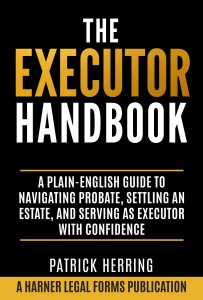
If you are the executor of an estate and you have questions about your title and responsibilities, you can find what you’re looking for in Pat Herring’s “The Executor Handbook”. Herring is the author of “The Estate Planning Handbook for Beginners” which was featured on this site earlier this summer.
Serving as executor is often one of the most demanding responsibilities a person will ever take on for a family member or friend.
“The Executor Handbook” explains what is expected of an executor in plain, easy-to-understand language. There are a lot of difficulties and challenges for an executor, even if you have done it before. One of the biggest challenges to handling an estate is fielding questions from relatives who want to know when assets will be disbursed. People don’t realize there is a process to an estate being opened and a careful inventory must be taken of what is included in the estate. If the executor is lucky, it will be easy to find everyone named in a will, locate them, and give them what the will dictates.
Unfortunately, that is not always the case. There may be heirs who have passed away, moved away, or don’t speak to the family anymore because of a falling out. All the while, there are other people who are anxious to lay claim to something that is in the estate. The executor must remind them of the importance of the will and funds as well as other property must go to people the will names.
How to Properly Maintain the Estate
Part of maintaining the estate includes dealing with informal agreements that were in place while the decedent was alive. These agreements may include use of a vehicle. If the vehicle is part of the estate, it must be held to as little use as possible to ensure its condition who whoever is slated to receive it through the will.
Some relatives will as about mementos and keepsakes. These seemingly insignificant items that aren’t worth much in an open market may hold enormous sentimental value. However, the executor must remember they are in charge of the estate and must be sure that everything is in its proper place until it determined what is to be given out and what is not. If the executor agrees to give something away and then realizes it was meant for someone else according to the will, that could make for some problems down the road.
Money is possibly the biggest example when it comes to sources of conflict in an estate. Relatives may approach the executor for small “loans” or try to pressure them into releasing some funds sooner than they should. The executor should resist these “requests” for two main reasons. First, they don’t know who is legally entitled to the money. Second, part of the money may need to go toward the upkeep of the property while the estate is going through probate. The executor must make sure each payout can be accounted for. This means record-keeping. Thorough records can help the executor keep track of where the money has gone. It can also provide an explanation if there are questions about money that seems to be missing.
Records provide clarity, and clarity reduces conflict.
Executors will face challenges and questions from multiple people. This can lead to difficult discussions and some disagreements. It is important for the executor to understand their obligation is to the estate and the final wishes of the decedent who made out the will. As mentioned before, what seems like a simple request can lead to trouble down the road with bookkeeping and making sure everything is accounted for and final wishes are honored. As Herring says in his book, “Fairness isn’t the same as pleasing everyone.”

“The Executor Handbook” is what’s needed to avoid trouble and confusion for executors and their families. Herring offers tips for those who have been faced with questions and difficult moments and conversations. Grieving the loss of a loved one is hard. Needing to explain to family why they can’t just take something from a house can make grief harder. When it comes to wills, estates, and their executors, an informal conversation no one else was party to won’t be good enough if someone wants something from the house, no matter how small or inconsequential it may seem. Also, the argument of “It’s what they would have wanted” won’t hold up in a court that looks for ironclad proof and documentation of an estate. That is the job and function of a will. Making sure the will is properly handled is the job and function of the executor. It’s not an easy job, but Herring’s book can help take some of the stress away.